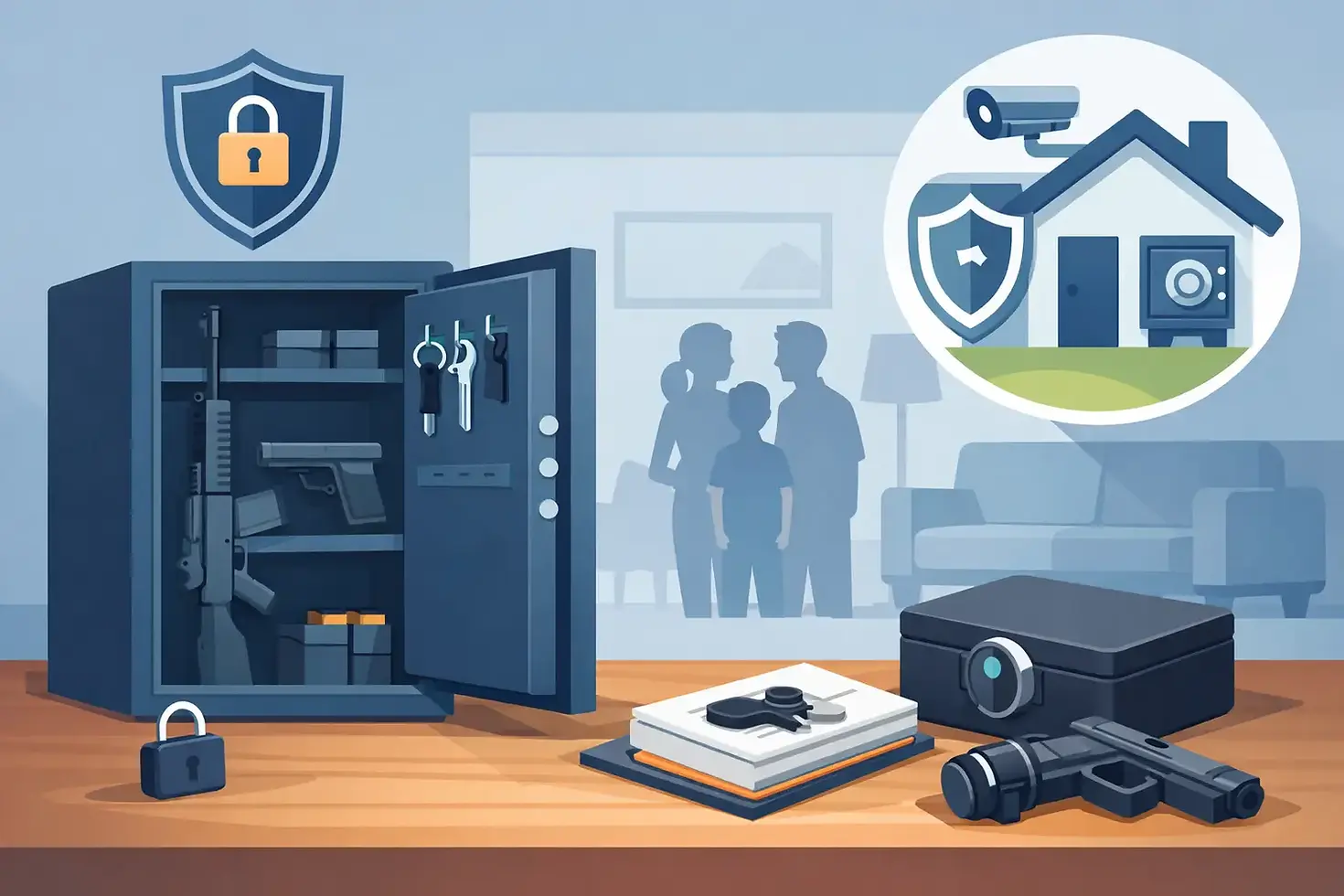
How to Store Firearms Safely in Your Home

A firearm left accessible to the wrong person can turn a moment of carelessness into a permanent tragedy. Knowing how to store firearms safely means planning for more than theft prevention. It means preventing unauthorized access, avoiding negligent discharges, protecting children and visitors, and maintaining control of every firearm in the home.
Safe storage is not a one-size-fits-all decision. The right setup depends on the number and type of firearms you own, who lives in or visits the residence, your need for lawful defensive access, and the storage requirements that apply where you live. The standard remains the same: only authorized, trained individuals should be able to access the firearm.
Start With Access Control
The central question is simple: who can get to the firearm when you are not directly controlling it? If the answer includes a child, guest, roommate, employee, or any person who is not authorized and trained, the storage arrangement needs improvement.
A firearm should not be stored loose in a drawer, under a mattress, on a shelf, in an unlocked vehicle, or in a bag that can be opened without a secure locking method. Hiding a firearm is not the same as securing it. Children are curious, visitors may enter spaces unexpectedly, and burglars often know where people commonly conceal valuables.
A locked container, safe, lockbox, or other secure storage device provides a physical barrier between the firearm and unauthorized access. The appropriate level of security depends on the environment. A home with young children, frequent visitors, or multiple occupants generally calls for a more restrictive storage method than a controlled residence occupied only by trained adults. Even then, secure storage remains the responsible baseline.
Before storing a firearm, follow the core safety rules: keep the muzzle in a safe direction, keep your finger off the trigger, and verify the firearm's condition yourself. Do not rely on memory, assumptions, or another person's statement that it is unloaded.
Choose the Right Storage Method
Different storage devices solve different problems. A full-size gun safe can provide strong theft deterrence and organized long-term storage for several firearms. A smaller lockbox may be better suited for a single firearm that requires controlled access. A locking cabinet can work for some collections, but its construction and locking system should be evaluated honestly. Not every cabinet provides the same resistance to forced entry.
For most owners, the selection comes down to security, access, and location. A larger safe usually offers better protection against theft and unauthorized handling, but it may be slower to access. A quick-access lockbox can reduce access time, but it must still be secured to a fixed surface when possible and kept away from children or untrained adults. Fast access should never mean open access.
Cable locks and trigger locks can add a layer of protection, particularly for temporary storage or when a firearm is being stored inside a locked container. They should not be viewed as a substitute for secure storage in a household where unauthorized people could reach the firearm. A firearm secured only by an external lock can still be stolen, mishandled, or removed from the home.
When choosing a safe or lockbox, consider its locking mechanism, construction, mounting options, capacity, and reliability. Electronic locks offer convenience but require battery management and a clear plan for failure. Mechanical locks avoid batteries but may take longer to operate. Biometric systems may offer rapid access, yet they should be tested regularly by every authorized user. No storage device is useful if its owner cannot operate it reliably under normal conditions.
Store Firearms Unloaded Unless Immediate Lawful Access Requires Otherwise
For routine, long-term storage, firearms should generally be unloaded and secured. Remove the firearm from service, verify its condition, and store it in a locked device that limits access to authorized users.
Some owners keep a firearm available for lawful personal protection. That decision involves real trade-offs. The firearm still needs protection from children, guests, and unauthorized adults, which is why a properly installed quick-access safe may be more appropriate than a nightstand drawer or unsecured bedside location. Every member of the household should understand that the safe is not a toy, the firearm is not to be handled without authorization, and access credentials are never to be shared.
Do not leave keys, override codes, or written access instructions in obvious locations near the storage device. A key hidden in the same room is not meaningful security. Access tools must be controlled with the same discipline as the firearm itself.
Keep Ammunition Organized and Accounted For
Ammunition should be stored in a cool, dry location, protected from moisture, excessive heat, and unauthorized access. For long-term storage, use appropriate containers and keep ammunition clearly separated from household chemicals, heat sources, and areas subject to water damage.
Whether ammunition should be stored separately from firearms depends on the household and the storage system. Separating it can add another barrier against misuse. In a properly secured safe or lockbox, ammunition may be stored within the same secured area if access is limited exclusively to responsible, authorized users. The objective is control, not a false sense of security created by placing ammunition a few feet away in an unlocked drawer.
Maintain an inventory of firearms, magazines, and ammunition. Record make, model, serial number, and a current description of each firearm. Store the inventory separately from the firearms, preferably in a secure location. This record can assist law enforcement and insurance providers if a firearm is lost or stolen, and it also helps identify missing property quickly.
How to Store Firearms Safely Around Children and Guests
Children do not need access to a firearm to be affected by unsafe storage. They can find it, handle it, show it to a friend, or bring it into a situation that escalates rapidly. The safest approach is layered: secure the firearm, control keys and codes, supervise access, and teach children to leave firearms alone and immediately tell an adult if they encounter one.
Do not assume a child is too young, too mature, or too unfamiliar with firearms to be at risk. Curiosity changes. Friends visit. Family routines change. A storage plan should account for the person who arrives unexpectedly, not just the people currently in the home.
Guests matter as well. Service workers, caregivers, extended family, and social visitors may enter bedrooms, offices, garages, or vehicles. Before hosting visitors, confirm that firearms are secured and that no access method has been left exposed. If someone in the home is experiencing a mental health crisis, substance misuse, domestic conflict, or another period of elevated risk, take immediate steps to prevent firearm access and seek appropriate professional support.
Do Not Treat Vehicle Storage as Home Storage
A vehicle is not an appropriate long-term storage location for a firearm. Vehicles are frequently targeted for theft, their interiors experience significant temperature changes, and an unsecured firearm can be quickly discovered during a break-in. If lawful transport is necessary, comply with applicable New Jersey requirements and use a locked case or other legally appropriate method.
Remove firearms from the vehicle as soon as practical after travel. If a brief stop makes temporary vehicle storage unavoidable, secure the firearm out of view in a locked container that is anchored when possible. Never leave it loose in a glove compartment, center console, door pocket, or under a seat.
Review New Jersey Requirements Before You Rely on a Routine
New Jersey firearm laws are detailed and can change through legislation, court decisions, agency guidance, and local circumstances. Storage, transportation, possession, access by minors, and defensive use can all carry legal consequences. A storage arrangement that appears reasonable may still create exposure if it does not meet current legal requirements or if an unauthorized person gains access.
Review current New Jersey requirements before purchasing a storage device or establishing a home-defense routine. This is especially relevant for households with minors, shared residences, security professionals, and anyone transporting firearms between home, work, training, or a lawful range destination. If you are uncertain about a specific legal obligation, obtain qualified legal guidance rather than relying on informal advice or social media discussions.
Professional firearms instruction should reinforce storage habits, not stop at range technique. ETSNJ training emphasizes the connection between safe handling, legal awareness, and responsible decision-making. Storage procedures should be practiced as deliberately as loading, unloading, and transport procedures.
A secure firearm storage plan should be checked regularly. Test the lock, replace batteries before they fail, confirm that keys and access credentials remain controlled, update your inventory, and reassess the plan whenever your household changes. Responsible ownership is not a device you buy once. It is a standard you maintain every day.


Comments